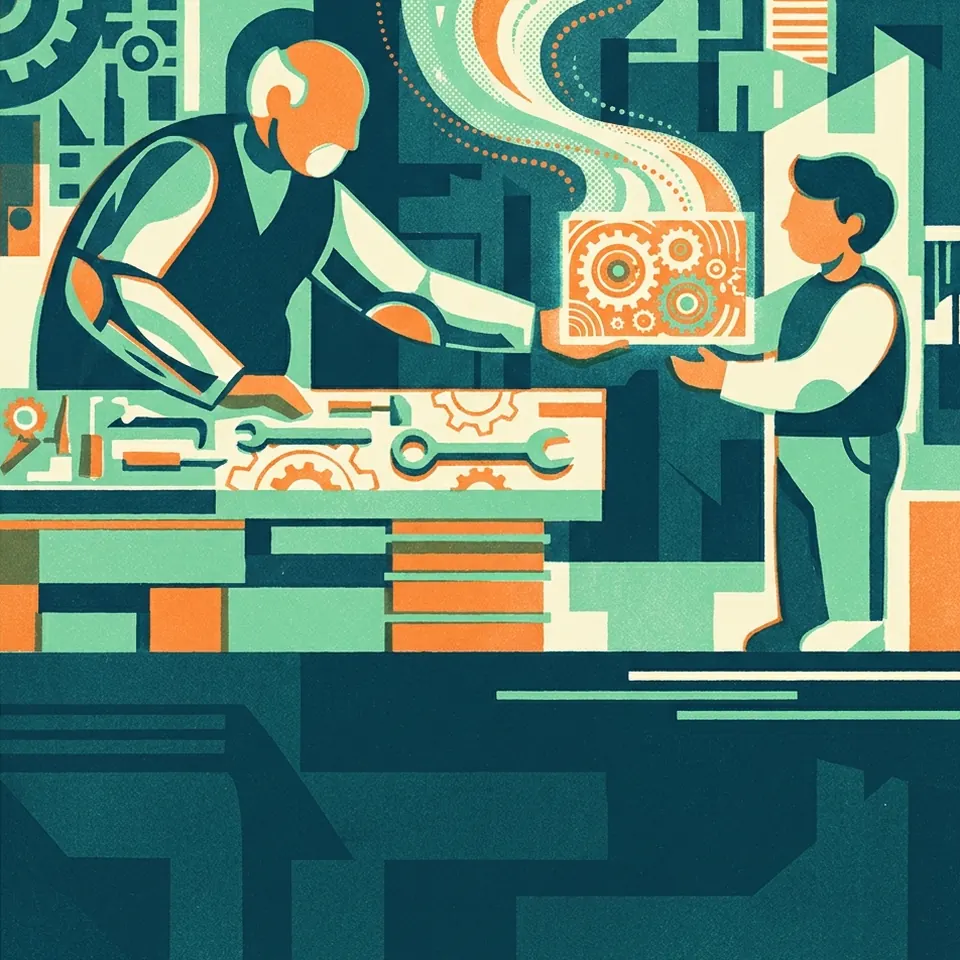
The problem
In many companies, key knowledge sits with a few experts. They know how the oldest systems work, who to call when things break, and how to fix problems that are not in any manual.
When these experts retire or take a new job, what they know leaves with them. The colleagues left behind have to figure it out all over again, which costs time and causes mistakes.
How organizations usually handle it
Companies usually try to solve this by asking the expert to write a handover document in their last two weeks. This is too late. A document can list passwords and daily tasks, but it cannot capture years of experience, quiet habits, or how to handle a real crisis.
How mentoring solves it
Mentoring means an experienced person meets a colleague regularly, over months, with a clear goal. Here, the goal is to pass on knowledge. The expert and the colleague who will take over meet every two weeks, often during real work, to talk through decisions and solve problems together.
Because they start long before the expert leaves, there is time to practice. The colleague watches, then helps, and finally does the work while the expert watches. By the time the expert leaves, the colleague is ready.
How it works on Mentornity
Match experts and colleagues
Mentornity AI and your matching rules propose a match between the expert and the colleague who will take over. Your team approves every match in one click.
Meetings every two weeks
Experts set their free hours once, repeating every week. Colleagues book a slot themselves, and both get a calendar invitation with a video link.
A next step after every meeting
Each meeting ends with the next step written down. The evening before the next meeting, everyone gets a summary, and a reminder to leave feedback follows after.
Help when meetings stop
If an expert and colleague have not met for 30 days, they appear on a silent list. Mentornity AI suggests an email to help them start again.
Or a mentor pool, with rules
Not every program needs fixed matches. In a pool program, mentors open their free hours and employees book them themselves. Rules still decide who sees whom: for example, an engineer sees only mentors from other departments.
 Mentor sees
 Mentee sees
What you can measure
Your team sees every booked and completed meeting in one list.
A weekly pulse asks how the week went with a score from one to five, and colleagues can ask your team for help.
Start and end surveys show how confident the colleague now feels doing the work alone.
Questions
Can we copy the program for different departments?
Yes. When you copy a program, the sessions, forms, matching rules, and program agreement come with it.
Do we have to match everyone manually?
No. Mentornity AI and your matching rules propose matches for you. Your team just reviews and approves them.
How do we know if the knowledge transfer is working?
The start and end surveys measure how confident the colleague feels. You can also check the weekly pulse score to see if they need help.